Stripe’s agreement to acquire OpenRouter is more than another large AI transaction. It is a strong signal about where the AI market is heading.
Stripe confirmed that OpenRouter helps businesses route and optimize token usage across more than 400 models from over 80 providers. The purchase price was not disclosed, although several publications have reported a value of more than $7 billion.
Why would a financial infrastructure company pay billions of dollars for an AI model routing platform?
Because enterprises are starting to realize that they will not use one model for everything.
Different models perform differently depending on the task. One model may be better at document analysis. Another may be better at coding. Another may be faster and less expensive for customer service. A more capable model may be required when the consequences of an error are significant.
The challenge is not simply selecting a model. It is selecting the right model for each use case while maintaining control over cost, quality, risk, and business value.
OpenRouter solves an important part of the problem
OpenRouter provides a common gateway to hundreds of AI models. It allows developers to access, compare, and route requests across model providers through a single interface.
This is increasingly valuable as the number of available models grows. Enterprises need the ability to change models, manage availability, control spending, and avoid becoming dependent on a single provider.
Stripe brings another important capability to this ecosystem: economic infrastructure. Stripe already helps companies measure usage, bill customers, manage payments, and optimize financial transactions. With OpenRouter, it can potentially connect AI model usage directly to metering, billing, and token economics.
OpenRouter routes the AI traffic.
Stripe measures and monetizes the traffic.
But an important enterprise question still remains: Should that AI work be performed in the first place?
Cost per token is not the same as business value
Selecting the cheapest model is not always the right decision. Selecting the model with the highest benchmark score is not always the right decision either. The correct choice depends on the use case.
For example, a lower-cost model may be sufficient to classify routine support requests. The same model may not be appropriate for reviewing a pharmaceutical safety document, supporting an energy grid decision, or identifying risk in a commercial contract.
Enterprises need to consider more than model price and general benchmark performance. They need to ask:
- What business outcome are we trying to create?
- How valuable is a successful outcome?
- What is the cost of an incorrect answer?
- What evidence is required before the output can be trusted?
- Does the response need to be grounded in approved enterprise data?
- Is human review required?
- What are the security, regulatory, and operational constraints?
- What is the fully loaded cost of the workflow?
- Did the AI system actually produce measurable business value?
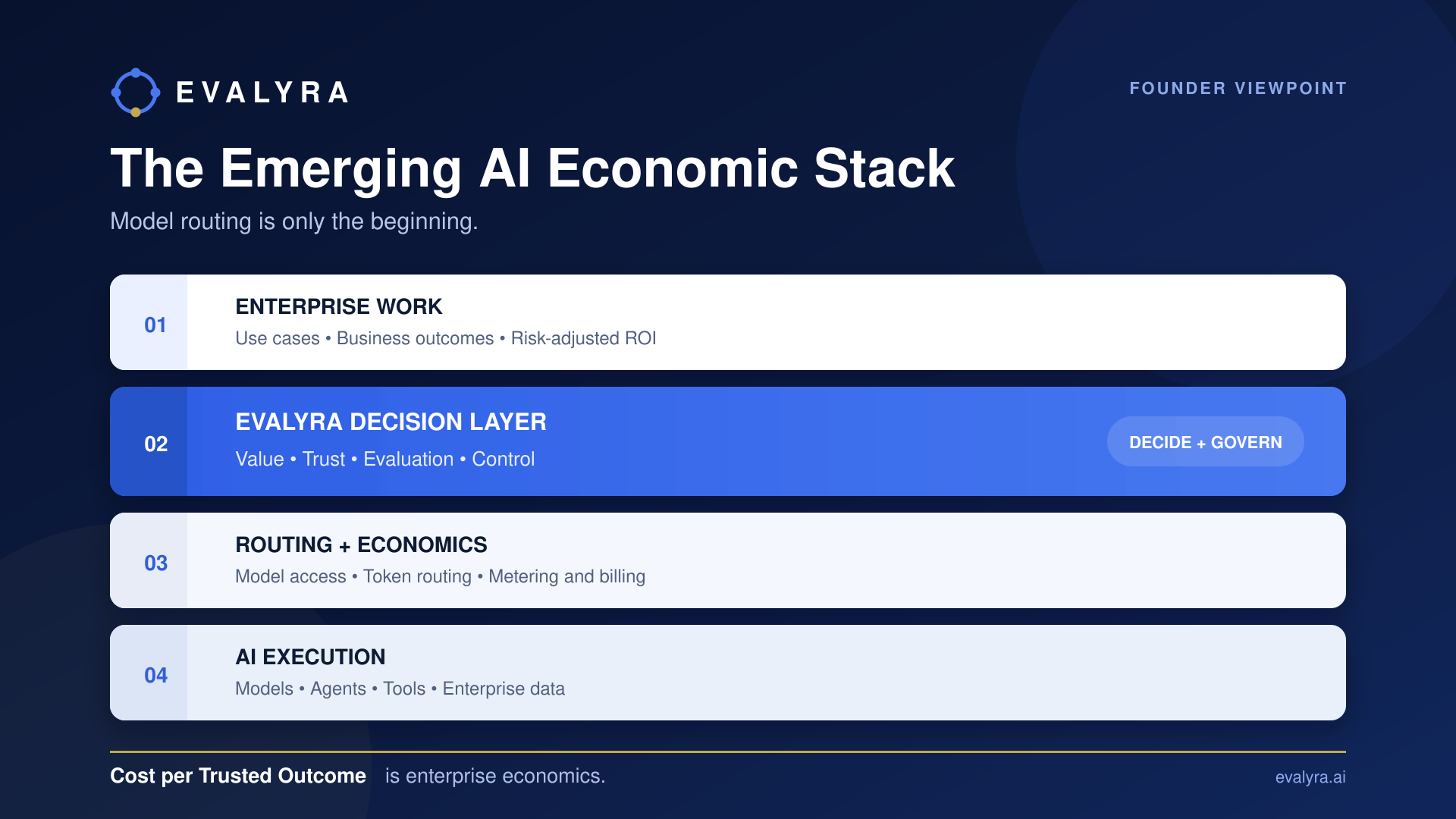
This is why I believe the next major layer of the AI stack will be an enterprise decision and economic value layer.
Where Evalyra fits
This is the problem we are building Evalyra to address.
Evalyra is being designed as an AI Enterprise Economic Value and Control Platform. The goal is not simply to route every request to the fastest or least expensive model.
The goal is to determine which AI work is worth doing, which systems can be trusted to do it, and whether the outcome creates enterprise value.
That requires connecting several capabilities:
- A registry of enterprise AI use cases
- Business value and risk criteria for each use case
- Golden datasets and evaluation scenarios
- Model and agent performance comparisons
- Cost, latency, quality, and reliability measurements
- Human review and policy requirements
- Recommendations for the most appropriate model or workflow
- Monitoring of real-world outcomes
- Measurement of risk-adjusted return on AI investment
The model router can then execute a decision based on these requirements.
Evalyra does not necessarily need to replace infrastructure such as OpenRouter, enterprise AI gateways, or cloud model platforms. It can sit above them.
An enterprise use case enters the Evalyra decision layer. Evalyra determines the value, risk, evidence requirements, and eligible models or agents. A routing platform then executes the model request. Usage and cost data return to Evalyra, where they can be connected to quality and business outcomes.
This creates a continuous learning loop. The platform learns not only which model produced an acceptable answer, but which complete AI workflow produced the best trusted business outcome.
From model routing to work routing
The longer-term opportunity is larger than model selection.
Enterprises will increasingly use AI agents to perform complete workflows involving multiple models, tools, data sources, approvals, and actions.
At that point, the question will no longer be: Which model should answer this prompt?
It will become: Which combination of models, agents, tools, data, and human judgment should perform this work?
Some work should be fully automated. Some work should require human approval. Some work should be routed to a more capable model because the cost of failure is high. Some work should not be performed by AI at all.
This is where governance, evaluation, routing, and economics begin to converge.
What the Stripe and OpenRouter transaction validates
This transaction validates several important ideas.
- The future is multi-model.
- Routing and interoperability will become critical enterprise infrastructure.
- Token usage and AI economics matter at scale.
- The companies that control the decision points between enterprise demand and model supply can become extremely valuable.
But the market is still early. Model access is becoming easier. The next challenge is helping enterprises decide where to use AI, when to trust it, and how to prove that it is creating value.
Cost per token is infrastructure economics.
Cost per Trusted Outcome is enterprise economics.
I am particularly interested in speaking with enterprise leaders in Indianapolis and across the Midwest who are working through these questions in life sciences, insurance, manufacturing, logistics, energy, healthcare, and financial services.
Where is your organization struggling today: selecting models, evaluating quality, controlling AI costs, governing agents, or proving return on AI investment?
I would welcome the conversation.
Sources: Stripe’s official announcement and Reuters reporting.